Wakeboard Terms Glossary: 45+ Words Every Rider Uses
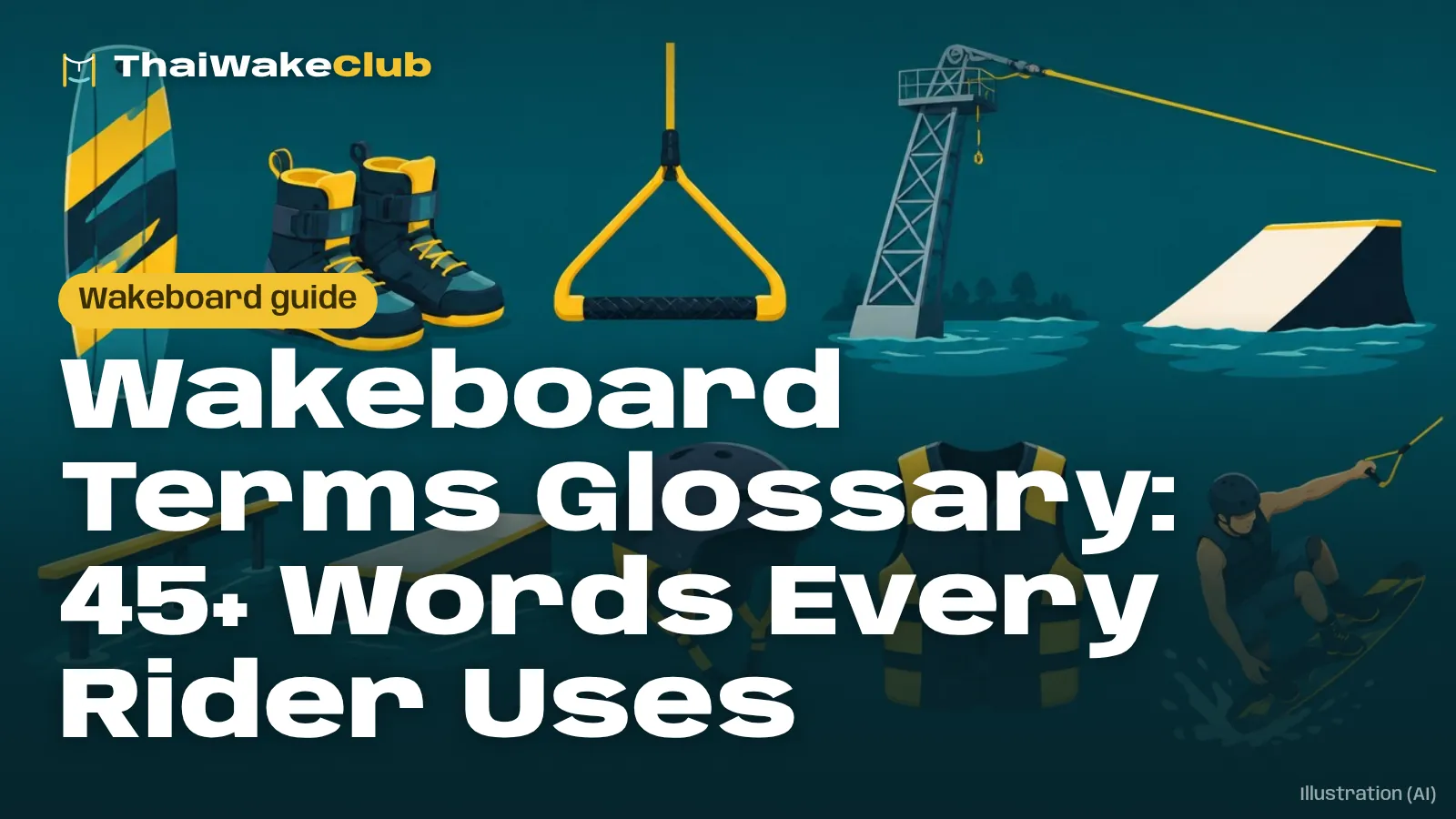
Wakeboarding has its own vocabulary, and at a cable park you will hear most of it on your first day: "regular or goofy?", "let go before the tower", "hit the kicker". This wakeboard terms glossary explains more than 45 common words in plain English, grouped by equipment, cable park, riding, tricks and obstacles.
Staff at Thai parks usually mix English terms into Thai, so the English words below are the ones you will actually hear on the dock. If you are new, read this alongside our beginner guide.
Equipment terms
| Term | Meaning |
|---|---|
| Wakeboard | A short, buoyant board ridden sideways, with both feet fixed in bindings. Most are twin-tip, so they ride the same in both directions. |
| Bindings (boots) | The boots screwed onto the board that hold your feet. Open-toe bindings fit a range of sizes; closed-toe boots fit more precisely. |
| Base | The underside of the board. Cable boards have a tough, grind-resistant base so they survive rails and boxes. |
| Rocker | The curve of the board from tip to tail. Continuous rocker is smooth and predictable; three-stage rocker gives more pop off the water but can feel harder to land. |
| Flex | How much a board bends. Flexible boards suit cable parks and pressing on obstacles; stiffer boards give a harder edge and more pop. |
| Fins | Small plastic keels on the base that help the board track straight. Many cable riders use small or no fins for easier spins. |
| Channels | Grooves moulded into the base that help the board track without big fins. |
| Edge / rail (of the board) | The sides of the board. You steer by putting weight on your heel edge or toe edge. |
| Handle | The bar you hold, attached to the rope. At cable parks it clips onto the carrier. |
| Rope | The line between the handle and the cable carrier, usually much shorter and stiffer at cable parks than behind a boat. |
| Impact vest | A slim foam vest that protects against falls and adds some flotation. Not the same as a life jacket. |
| Life jacket / buoyancy aid | A vest built mainly to keep you afloat. Thai parks hand these out to beginners and require a vest on the water. |
| Helmet | A water-sports helmet with drainage. Some parks include one; others rent it separately. |
| Kneeboard | A short board you ride kneeling, often used by first-timers or kids before standing up. |
| Wakeskate | A board with no bindings, ridden like a skateboard on the water. Harder than wakeboarding and a separate rental at some parks. |
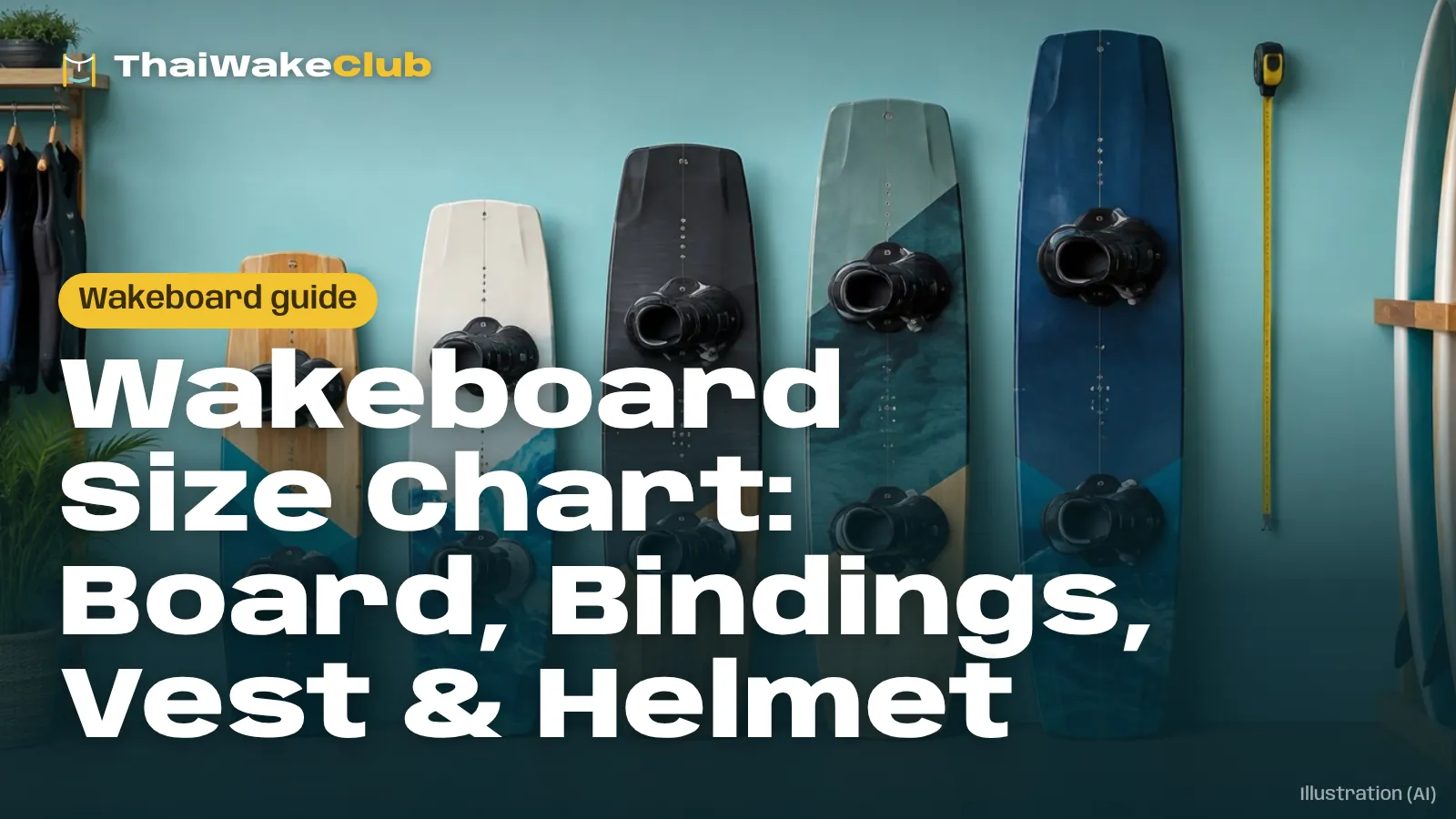
For sizing these items, see our wakeboard size guide.
Cable park terms
| Term | Meaning |
|---|---|
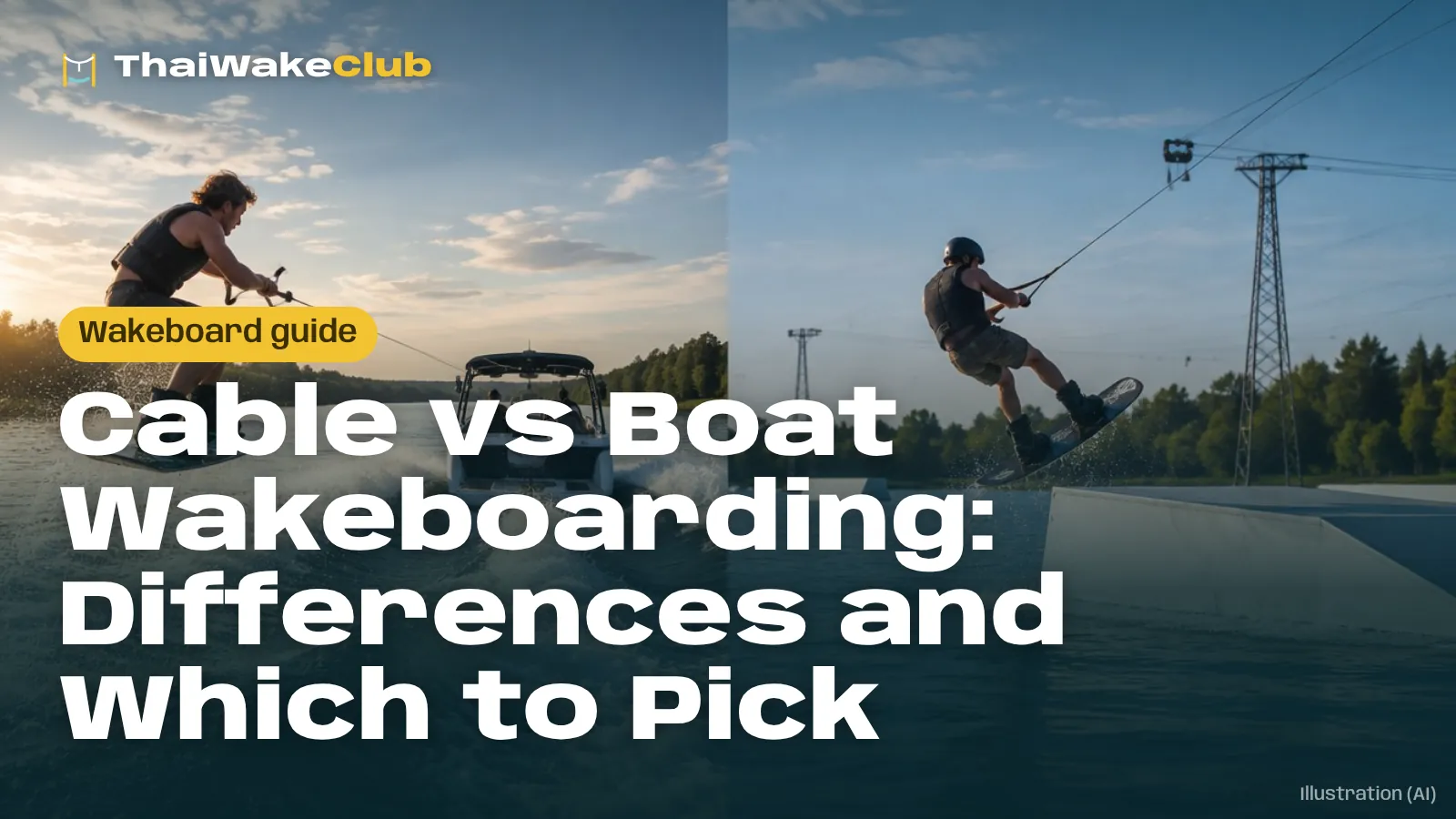
| Cable park | A lake where an overhead cable, driven by an electric motor, tows riders instead of a boat. |
| Full-size cable | A loop of usually five towers that tows several riders at once in one direction. You buy shared time. |
| 2-tower cable (System 2.0) | A straight line between two towers that runs back and forth. The operator sets the speed, so it is ideal for lessons. |
| Tower | The tall poles holding up the cable. On a full-size loop, the corners are at the towers. |
| Carrier | The clip that runs along the cable and pulls your rope. Staff attach your handle to a carrier at the start. |
| Start dock | The platform where you begin. You either stand on the edge or sit, and the carrier pulls you off. |
| Corner | The turns at each tower. The cable changes direction sharply, so you must hold on and keep the line tight. |
| Operator | The staff member controlling the cable, speed and stops from the control booth. |
| Low speed / beginner speed | A slower cable setting for first rides and kids. Some parks sell dedicated low-speed sessions. |
| Let go | Releasing the handle on purpose, for example before a fall or when you cannot make a corner. The handle then rides the cable back. |
| Swim-out | Swimming to the bank after a fall, out of the path of the next rider. |
| Lap | One full circuit of the cable. |
| Pass | One run along a 2-tower line from one end to the other. |
| Set | A block of riding time, common at 2-tower parks (for example a 10-minute set). |
Riding terms
| Term | Meaning |
|---|---|
| Regular | Riding with your left foot forward. |
| Goofy | Riding with your right foot forward. |
| Switch / fakie | Riding with your non-natural foot forward. On a twin-tip board this is normal practice. |
| Heelside | Leaning back onto your heels and the heel edge. |
| Toeside | Leaning onto your toes and the toe edge, with your chest facing the water. |
| Carve | A smooth, continuous turn on one edge. |
| Edging | Pushing hard against the edge to build speed and tension in the rope before a trick. |
| Slack | A loose rope. Slack can jerk you when it snaps tight, so riders try to keep the line taut. |
| Deep-water start | Starting from floating in the water, mainly used on boats and some 2-tower lines. |
| Dock start | Starting from the platform, the standard at cable parks. |
| Crash / wipeout | Any fall. Releasing the handle early keeps it controlled. |
| Stance | Your foot position: which foot leads, how wide, and the binding angles. |
Trick terms
| Term | Meaning |
|---|---|
| Ollie | Popping the board off flat water by loading the tail and springing up. The foundation of most tricks. |
| Butter | A flat-water press or spin on the water's surface, usually low-risk. |
| Surface 180 / 360 | Turning the board 180 or 360 degrees on the water without jumping. |
| Grab | Grabbing the board in the air. Common grabs include indy (toe edge, back hand) and melon (heel edge, front hand). |
| Spin (180, 360, 540) | A rotation in the air, named by degrees. |
| Backroll | An inverted trick that rolls sideways off the heel edge. |
| Tantrum | A backflip off the heel edge, without help from a kicker. |
| Raley | A trick where the rider's body extends out behind them before landing. |
| Air pass | Letting go with one hand and passing the handle behind your back in the air. |
| Handle pass | Passing the handle behind your back during a spin. |
| Landing | Touching back down. Aim to land slightly on the tail with knees soft. |
To start learning the easiest ones, see first wakeboard tricks.
Obstacle (feature) terms
| Term | Meaning |
|---|---|
| Feature / obstacle | Any ramp, box or rail placed in the water. |
| Kicker | A jump ramp that launches you into the air. The most common first obstacle. |
| Table / funbox | A flat-topped ramp with ramps up and down, used to ride over or slide. |
| Slider / box | A wide, flat surface you slide on with the board's base. Easier than a rail. |
| Rail | A narrow pipe or bar you slide along. Requires more balance than a box. |
| Pipe | A round slider, often curved or bent. |
| Pool gap | A jump from the water over a gap onto or off a feature. Some 2-tower lines are built around one. |
| Air trick | Any trick done off a kicker. |
| Board slide | Sliding a feature with the board perpendicular to it. |
| 50-50 | Sliding a feature with the board parallel to it. |
| Transfer | Jumping from one feature to another. |
| Obstacle priority | The park rule about who gets to ride a feature when riders are close; usually the rider in front goes first. |
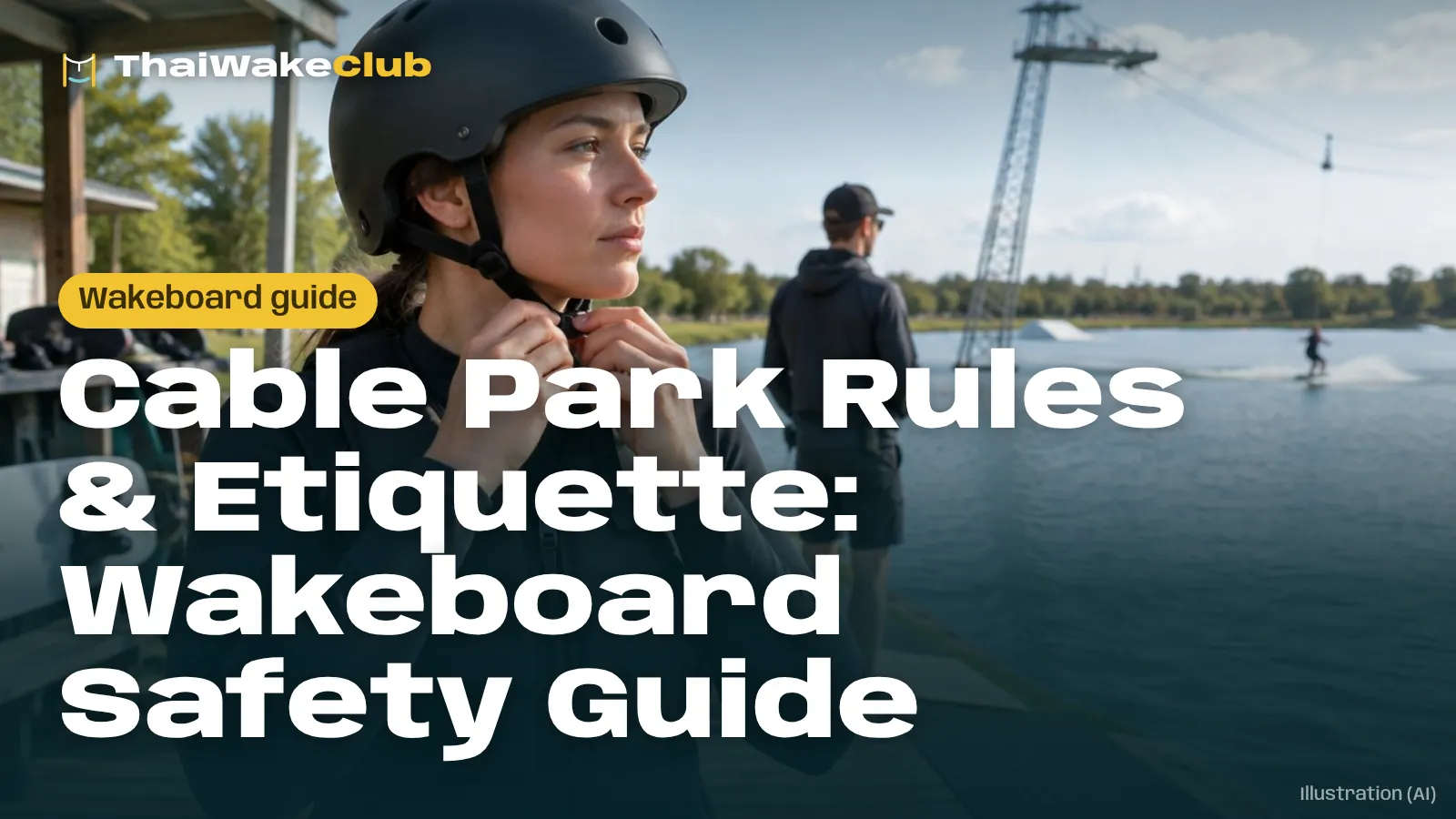
Before hitting features, read our cable park rules and etiquette.
Using these terms at a Thai park
At Thai Wake Park Lumlukka and ESC Thai Wake Park, first-timers usually begin on a 2-tower training line before moving to the full-size cable, so "2.0", "low speed" and "carrier" are the first words you will hear. At beginner-focused 2-tower parks such as WakeGarden Wake Park, the coach sets the speed for you. Prices and session formats are covered in our wakeboarding price guide.
FAQ
What is the difference between regular and goofy in wakeboarding?
Regular means your left foot is in front; goofy means your right foot is in front. Neither is better. Coaches often find yours by gently pushing you from behind and seeing which foot steps forward.
What does "let go" mean at a cable park?
It means release the handle on purpose. You should let go when you are falling, when you cannot make a corner, or when told by staff, so the handle travels on without dragging you.
What is a kicker?
A kicker is a jump ramp in the water. It is usually the first obstacle riders try after they are comfortable on flat water.
What is the difference between a full-size cable and a 2-tower cable?
A full-size cable is a loop of several towers that tows many riders in one direction. A 2-tower cable runs back and forth on a straight line, and the operator controls the speed, which makes it better for lessons.
Do I need to know these terms before my first session?
No. Staff will guide you on the day. Knowing a few words, such as regular, goofy, let go, heelside and toeside, simply makes the instructions easier to follow.